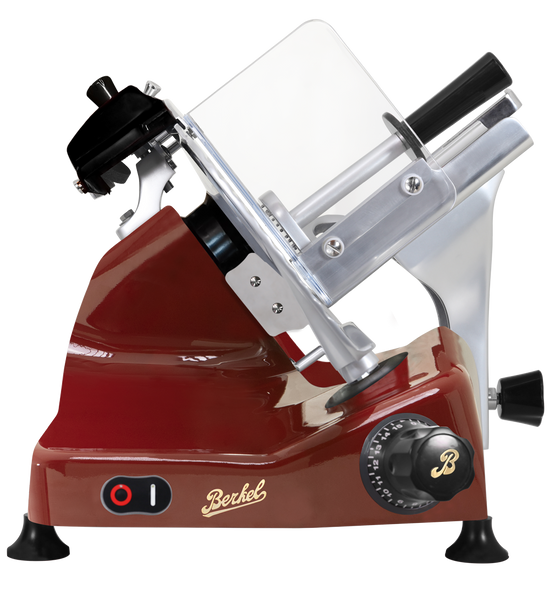
Before investing in a meat slicer, you must make sure that the machine will be suitable for your products. There is a range of slicers designed for different sizes, textures, and product types. Blade diameter is only a small part of a slicer’s cutting capacity.
Berkel, a renowned brand in the meat slicer industry, advises customers to consider circular and rectangular cutting capacities when assessing product size.
Measure Your Products
Start by measuring the largest products you regularly slice.
For a round product, such as salami, measure its diameter at the widest point and its overall length. For a boneless cooked joint, such as ham, measure the width and height of the face you intend to slice, then the length of the whole joint. The slice face is the cross-section that determines the shape and size of each slice.
Check along the whole product, as a narrow end may lead into a much broader section. For irregular joints, measure the greatest width and height. Overall length also matters because the product needs to be supported and held securely.
| Specification | What it tells the customer |
|---|---|
| Blade diameter | The diameter of the circular blade. |
| Circular cutting capacity | The maximum diameter for a round product. |
| Rectangular cutting capacity | The height and width dimensions of a rectangular slice face. |
| Carriage travel or stroke | How far the moving carriage travels during a slicing pass. |
| Product table and holder | The parts that support the product and hold it in position while slicing. |
Use the capacity figure that matches your product’s shape, and check the orientation shown in the manufacturer’s drawing. Slice thickness is a separate measurement: “0–14 mm” describes the thickness adjustment, not the size of joint the slicer can accommodate.
Example Models
| Product | Blade diameter | Circular cutting capacity | Rectangular cutting capacity |
|---|---|---|---|
| Berkel Pro Line XS25 Gravity | 250 mm | 188 mm | 225 × 178 mm |
| Berkel Pro Line XS30 Gravity | 300 mm | 230 mm | 245 × 195 mm |
| Berkel Domina Gravity SLG350 | 350 mm | 230 mm | 285 × 215 mm |
Sources: Berkel’s Pro Line XS specification sheet and Berkel’s SLG350 product page.
These figures are a starting point for selection. Check your own products, including their widest sections, before choosing a machine.
Check Carriage Movement and the Product Holder
During slicing, the carriage carries the product past the blade. There must be enough movement to complete the cut without the product or holder catching on anything.
Carriage travel is different from feeding the product towards the plate that sets slice thickness. It is also a separate measurement from the length of the joint.
Always check whether:
- The product can sit in the correct loading position with the holder securing it.
- The carriage can complete its movement without obstruction.
- The bench layout leaves enough space to load the product and move the carriage.
If the specification sheet does not give the carriage travel or available holder clearance, contact our team for assistance. These cannot be worked out from the machine’s overall dimensions alone.
Follow the loading and holder instructions in the manual supplied with your slicer. Do not remove or bypass guards to accommodate a larger product, or hold the food directly by hand while slicing.
Buying Checklist
When enquiring, provide:
- Product type and whether it is boneless.
- Maximum diameter, or slice-face width and height.
- Overall product length.
- A photograph showing its shape.
- Desired slice thickness.
- Available bench space, including room for carriage movement.
Unsure which slicer size is right for your products? Contact our team. We can help you compare suitable models and check their cutting capacity, loading space, and product-holder arrangement.