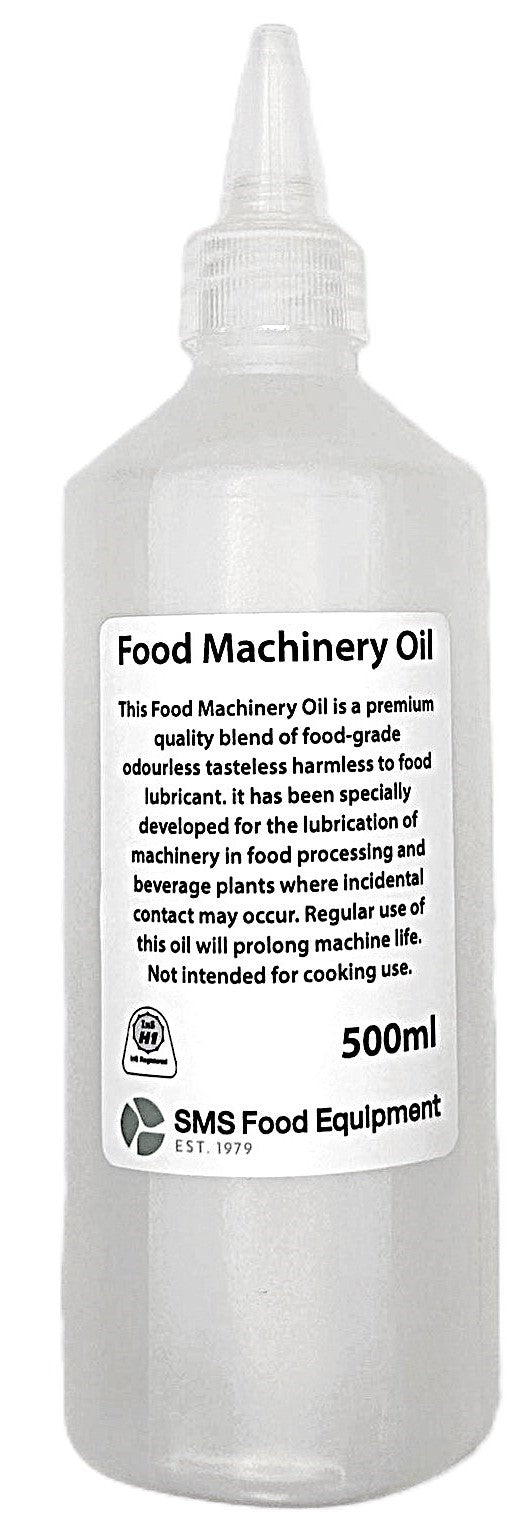
Before lubricating a slicer, mincer, or other food processing machine, check which oil the manufacturer recommends. A product labelled “food grade” may not meet the requirements of the part you are lubricating. Using the wrong lubricant can damage components or introduce contamination.
This guide explains food-grade lubricant labels, the documents to check, and why your machine’s maintenance instructions matter.
What Does “Food Grade” Actually Mean?
The term "food grade" is often used loosely to describe a product that can be safely kept in a food environment. Food machinery lubricants are formulated to reduce friction, prevent mechanical wear, and protect parts against rust. Being food grade does not mean that it is edible or tell you where it can be used on the machine.
NSF’s registration scheme assesses formulations and product labels against requirements for particular uses. The most significant registration for food businesses is whether it is safe for incidental food contact. This is the unintended contact between a lubricant and food during processing.
H1 registration covers safety where this type of contact may occur. It does not permit deliberate addition to food or mean that a leak can be ignored. If lubricant reaches food unexpectedly, stop the machine and assess the products.
For UK food businesses, the focus is on minimising any contamination risks when maintaining equipment. NSF classifications can help you assess a lubricant’s intended use, but they do not replace food hygiene requirements or the machine manufacturer’s instructions.
Understanding Food Grade Classifications
NSF uses several categories to identify products’ intended applications. The four below should be checked for products used around food machinery. They describe uses, rather than ranking product quality.
| Classification | What It Means | What Customers Should Understand |
|---|---|---|
| H1 | Lubrication where incidental food contact may occur. | Follow the product’s restrictions and check that it meets the machine’s specification. |
| H2 | Lubrication where there is no possibility of food contact. | Do not use it where lubricant could reach food. |
| H3 | Soluble oils used for rust protection on items such as hooks and trolleys. | Treated food-contact equipment must be washed or wiped before returning to service, following the product’s conditions. |
| 3H | Release agents that prevent food from sticking to specified surfaces. | Check the permitted surfaces and applications. This category does not establish suitability for every lubrication task. |
The NSF category guide outlines these registration conditions to help businesses apply the right chemical.
What Is ISO 21469?
Some lubricants also carry ISO 21469 certification. H1 registration includes a review of the formulation and label, while NSF’s ISO 21469 certification also assesses manufacturing hygiene, facility audits, and product testing.
This provides further assurance about how the lubricant is produced and controlled. You still need to check that it meets your machine’s lubrication requirements.
Manufacturer Instructions and Product Documentation
A lubricant’s food-contact classification does not tell you whether it will work correctly in a particular machine. Different components may need different oils or greases. Check the manual for your exact model to find out:
- Whether the component needs lubrication.
- Whether the task can be carried out by a trained operator or needs a service engineer.
- Which lubricant type and specification are required.
- Where to apply it and how much to use.
- When lubrication is needed.
- Whether alternative products are permitted.
Before applying, compare the following information with your machine’s requirements.
| Document or Detail | What to Check |
|---|---|
| Product label | Exact product name, grade, intended applications, and directions for use. Make sure the supporting documents match the product you have. |
| Technical data sheet (TDS) | Required performance specifications, oil viscosity/consistency, operating temperatures, and suitability for the intended component. |
| Compatibility | Suitability for relevant seals and other materials, and whether the product can be used with the existing lubricant. |
| Registration or certification evidence | Exact product and grade, category, registration or certificate number, current status and any restrictions. |
| Safety data sheet | Handling, protective equipment, first aid and spill precautions. |
| Storage and shelf-life information | Recommended storage conditions, shelf life, and whether the container remains clearly labelled and uncontaminated. |
The technical data sheet helps you judge whether the lubricant will do the required job. The safety data sheet explains how to handle it safely, but it is not proof that a lubricant is safe for food contact. Registration information supports particular food-contact claims. You need to read these alongside the machine’s manual.
If the specification or supporting information is missing, ask the supplier before using the product.
For NSF claims, you can verify products in the NSF White Book product directory. Always search for the specific product, rather than just the brand.
Using the Correct Lubricant Properly
Once you have chosen the correct lubricant, follow the maintenance instructions when applying it:
- Stop the machine and isolate the power.
- Protect nearby food and food-contact surfaces.
- Apply the specified amount at the correct lubrication points.
- Remove excess lubricant or protective films where the instructions require it.
- Use clean applicators labelled for the lubricant they contain. Keep incompatible products separate.
- Check compatibility before topping up or changing products.
- Close containers after use and store them as directed, protected from contamination.
Two H1 lubricants are not automatically interchangeable. If you are changing products, cleaning or another changeover procedure may be required.
Choosing Machinery Oil with SMS Food
At SMS Food, we stock high-quality, food-grade machinery oil that can be used on a variety of equipment. Before using it, check the product information against the lubrication requirements for your machine.
If you need help, contact us with the make, model, and part you need to lubricate. For maintenance that requires an engineer, see our machinery servicing and repairs.