Food businesses frequently require their staff to lift heavy objects. Carrying deliveries, tipping ingredients into a mixer, and moving bowls to the cleaning area can put considerable strain on staff.
Reducing that strain starts with looking at how ingredients and equipment move through your workplace. Changes to storage, loading arrangements or the distance between workstations can sometimes remove an awkward lift altogether.
Manual handling includes lifting, lowering, carrying, pushing, and pulling. Repeatedly moving smaller, awkward loads throughout a busy shift can also create a serious injury risk.
What Are the Legal Requirements?
Under the Manual Handling Operations Regulations 1992, as amended, employers in Great Britain must:
- Avoid hazardous manual handling where reasonably practicable.
- Assess the risk of injury from hazardous handling that remains necessary.
- Reduce that risk to the lowest level reasonably practicable.
These specific duties connect to your wider requirements for safe working under the Health and Safety at Work Act 1974.
There is no universal legal maximum lifting weight. A load below 25 kg is not automatically safe. The risk depends on how it is handled, the working conditions and the person doing the task.
Identify the Difficult Handling Tasks
Walk through the working day with the staff who carry out these tasks. Include cleaning and maintenance, when bowls, paddles, and other machine parts may need to be removed and moved. Consider these four main areas:
| Area | What to consider? |
|---|---|
| Task | How often is the load moved? Does the task involve twisting, reaching, tipping or carrying it a long distance? |
| Load | Consider its weight, size, shape, grip and stability. Is it hot, slippery or sharp, or could its contents shift? |
| Working environment | Check space, lighting, floor condition, doorways, steps and the route between work areas. |
| Individual capability | Consider whether the task suits the worker and whether adjustments are needed, including for an existing injury or pregnancy. |
HSE’s MAC tool can assess lifting, carrying and team-handling tasks. Its RAPP tool covers pushing and pulling. Use these tools to identify problem areas and prioritise improvements alongside your assessment of the actual work.
Where hazardous handling cannot be avoided, assess how to reduce the risk. Provide mechanical assistance where practicable, alongside reducing the load, changing the working height or shortening the carrying distance.
Remove Unnecessary Lifts and Carrying
Changes to deliveries, storage, and production layout can drastically reduce handling. Consider:
- Storage: “Keep frequently used, heavier items within comfortable reach, avoiding positions that require staff to bend deeply or lift above shoulder height.”
- Smaller packs: “Consider smaller ingredient packs, but assess the whole task: reducing the weight of each load may increase the number of lifts.”
- Delivery arrangements: “Agree a suitable delivery point close to storage, with a clear route for the handling equipment.”
- Sliding loads: “Where the surfaces, load and transfer route allow it, supported movement between workstations may reduce lifting.”
| Current Task | Improvement to Consider |
|---|---|
| Carrying heavy tubs repeatedly across the wet preparation room. | Reposition workstations closer together or provide a suitable, stable trolley and keep the route clear of hoses. |
| Lifting heavy ingredient sacks from the floor up into a hopper. | Review pack size, storage height, and whether a suitable mechanical lifting aid can serve the machine safely. |
| Carrying a large, hot pot between cooking and serving areas. | Review your cooking, dispensing, and serving arrangements to reduce the physical movement of the full pot. |
| Lifting overloaded dishwasher racks. | Strictly reduce rack loads and arrange surfaces to allow supported sliding transfer where suitable. |
Choose Handling Aids That Suit the Task
If a lift cannot be avoided, you must provide mechanical help. Consider trolleys, bowl dollies, mobile lift tables, and suitable lifting or tipping equipment. Before choosing a handling aid, check:
- Its stated load capacity and suitability for the container’s size and shape.
- Whether the load can be supported securely.
- Clearance through doors and around equipment.
- Suitability for the floor, thresholds and any slopes.
- How staff will load and unload it.
- Whether its materials and construction suit the cleaning method.
- Where it will be stored so it is readily available.
Handling aids used at work must be suitable, maintained and used safely under PUWER. Where an aid falls within LOLER’s scope, additional requirements apply, including thorough examination when required.
Check How Food Machinery is Loaded, Emptied, and Cleaned
When buying new machinery, you must consider the physical handling required of the machine:
- How high must heavy ingredients be lifted to reach the hopper?
- How far must the operator reach across the machine?
- Can the receiving container sit securely beneath the discharge point without being held?
- Does the machine empty cleanly into manageable containers?
- Which heavy metal bowls, paddles, or plates must be removed for cleaning?
- What do the removable parts weigh, and how will staff move them to the cleaning area?
- Is there sufficient floor space around the machine for any proposed handling aid?
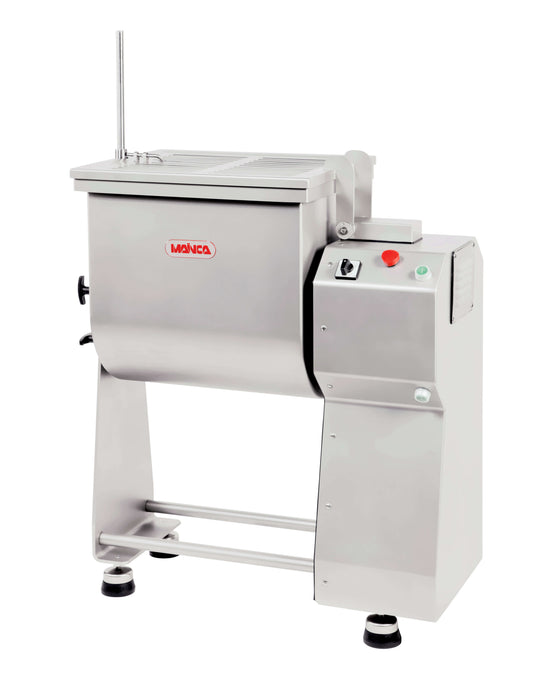
The AK-Ramon AMM-55 S Meat Mixer has a tilting bowl, wheels, and a handle. These are useful features to consider when planning how the machine will be emptied and moved. The Mainca RC100 Kneader Meat Mixer also has a tilting bowl, together with removable paddles for cleaning.
A tilting bowl can make emptying easier, but the receiving container still needs to be positioned and moved safely. Check the whole process, including loading ingredients and handling removable parts.
Train Staff for the Tasks They Actually Perform
Good handling technique supports safer work, but training alone cannot make an unsuitable task safe. First, reduce the risks through the task, equipment and workplace layout. Training should cover:
- The business's agreed method for each relevant physical task.
- The correct, safe use of all handling aids and trolleys.
- Checking the load and the route before moving anything.
- Recognising exactly when a task cannot be completed safely.
- Reporting damaged equipment.
- Practical demonstrations followed by supervised practice.
Where manual lifting remains appropriate, staff should plan the movement, establish a stable position and secure a good grip. Keep the load close where safe, move smoothly and turn with the feet rather than twisting while lifting. Stop and seek assistance if the task cannot be completed safely.
Team lifting requires an agreed method, coordination, and enough space. A second person does not automatically make a lift safe or double the load that can be handled.
Provide training when staff start work and when changes introduce new or increased risks. Repeat it periodically where appropriate and check that staff can apply it in practice. There is no universal legal requirement to renew a manual handling certificate annually.
Encourage Early Reporting
Staff should report physical discomfort, exceptionally difficult tasks, damaged aids, and near misses promptly. Managers should investigate the work and consider adjustments.
Review the assessment when changes could affect handling risks, for example, increased batch sizes, new equipment, different containers, or a change in a worker’s capabilities. Also review it after an injury or near miss, or when staff report discomfort or difficulties.
If you employ five or more people, you must record the significant findings of your risk assessment, including the hazards, who could be harmed and the controls in place. Businesses with fewer than five employees must still assess and control risks, even though this general recording requirement does not apply.
Before choosing a machine, consider how staff will load, empty and clean it. Share your usual batch sizes, container dimensions and available space with our team. We can help you compare loading, emptying, and cleaning features before you choose.